
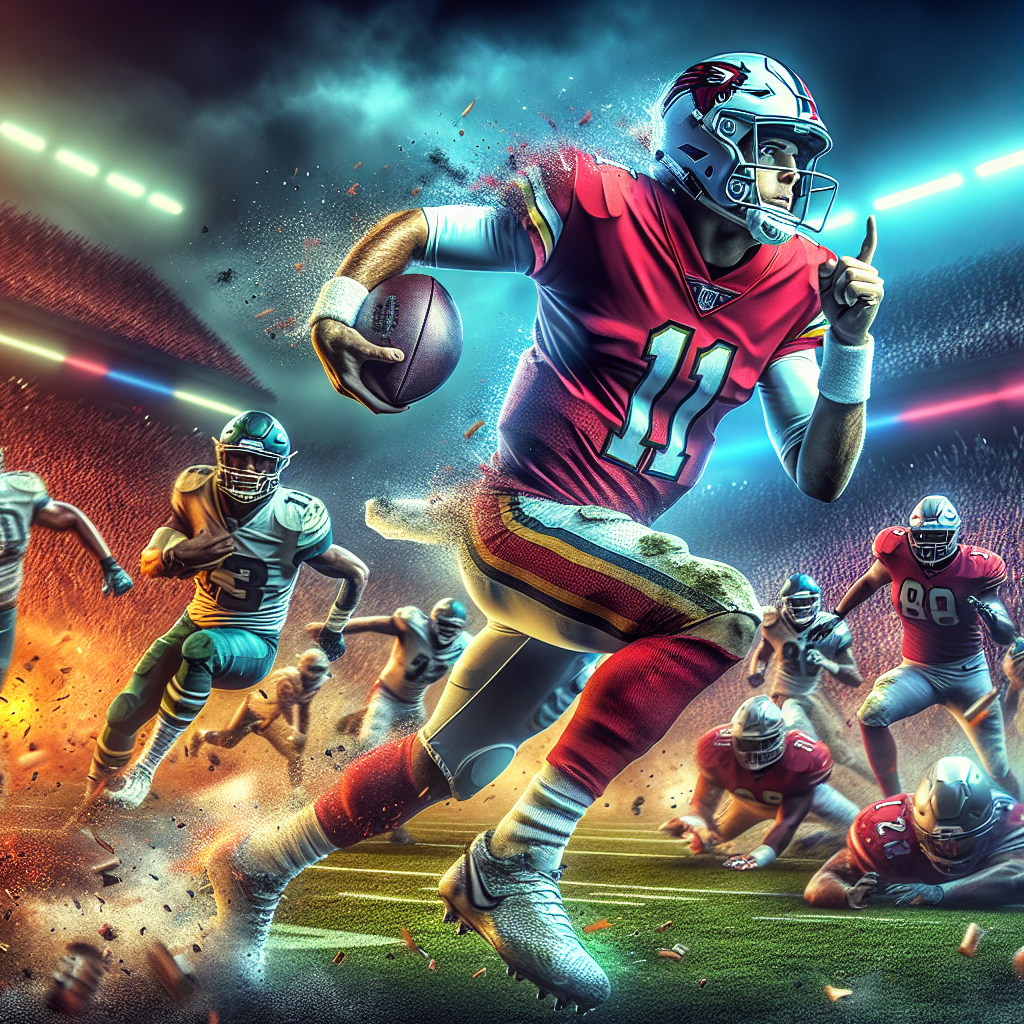
The Dual-Threat Advantage: Why Mobile QBs are the Key to NFL Success
The NFL has always been a league of evolution, where yesterday’s innovation is today’s standard. And right now, the game is being revolutionized by a new breed of quarterback: the dual-threat. These quarterbacks, capable of dissecting defenses with both their arms and their legs, are not just a trend; they represent the future of offensive football. Just ask the Kansas City Chiefs, who watched Patrick Mahomes rack up 389 rushing yards in the 2024-2025 regular season, proving that mobility is more than just a luxury – it’s a weapon.
The Evolution of the Quarterback
For decades, the prototypical NFL quarterback was a pocket passer, a statue of poise and precision. Names like Tom Brady and Peyton Manning dominated the league, showcasing the power of a quarterback who could read defenses and deliver pinpoint passes from within the pocket. But as defenses have become faster and more complex, the ability to escape pressure and extend plays has become increasingly valuable.
Historically, dual-threat quarterbacks were less common in the NFL. While players like Steve Young and John Elway had success running in the 1980s and 1990s, it wasn’t until the emergence of Michael Vick in the early 2000s that the league truly began to appreciate the potential of a quarterback who could be a legitimate running threat. Vick’s electrifying runs and improvisational skills forced defenses to account for a new dimension of the game.
The Numbers Don’t Lie: Dual-Threat QBs are Changing the Game
The rise of the dual-threat quarterback is backed by compelling statistics. In 2022, Jalen Hurts of the Philadelphia Eagles finished the season with 760 rushing yards and 13 rushing touchdowns. Josh Allen of the Buffalo Bills has consistently notched over 750 rushing yards while throwing for over 4,000 yards, establishing himself as one of the most dangerous offensive threats in the league. Lamar Jackson holds the record for most rushing yards with 6,173 yards by a quarterback.
These numbers underscore a clear trend: quarterbacks who can run are not just extending plays; they are actively contributing to their team’s rushing attack and overall offensive production.
Offensive Schemes Adapt to the Dual-Threat
The emergence of the dual-threat quarterback has forced offensive coordinators to adapt their schemes to maximize their quarterback’s unique skill set. Greg Roman, former offensive coordinator for the Baltimore Ravens, famously built Baltimore’s playbook around Lamar Jackson’s dual-threat talents. The Ravens became the NFL’s most dangerous rushing offense, regularly leading the league in rushing yards, while Jackson continued to develop as a passer.
Similarly, the Philadelphia Eagles designed an RPO (run-pass option) heavy offense tailored to Jalen Hurts, allowing him to make split-second decisions on whether to throw or run based on defensive alignments. These RPO systems put immense pressure on defenses, forcing them to defend every inch of the field.
Key Dual-Threat Quarterbacks in Today’s NFL
- Lamar Jackson (Baltimore Ravens): Jackson, the 2019 NFL MVP, has redefined the quarterback position with his unparalleled rushing ability and improving passing skills. In the 2024-2025 season, Jackson threw for 4,172 yards and 41 touchdowns, while also rushing for 915 yards.
- Josh Allen (Buffalo Bills): Allen’s combination of size, arm strength, and running ability makes him a nightmare for opposing defenses. Allen has 4,142 rushing yards in his career.
- Patrick Mahomes (Kansas City Chiefs): While known for his incredible arm talent and improvisational passing, Mahomes is also a sneaky effective runner, with 2,243 rushing yards in his career.
- Jalen Hurts (Philadelphia Eagles): Hurts has quickly established himself as one of the league’s premier dual-threat quarterbacks, leading the Eagles to Super Bowl LVII. Hurts has 3,133 rushing yards in his career.
The Defensive Response: Containing the Mobile QB
Defensive coordinators are constantly searching for ways to contain the dual-threat quarterback. Traditional strategies like assigning a linebacker to “spy” on the quarterback are still used, but modern defenses are also incorporating more sophisticated techniques.
One popular approach is to utilize “zone read” principles, where a defensive end is tasked with reading the quarterback’s eyes and reacting accordingly. If the quarterback keeps the ball, the end crashes down to tackle him; if the quarterback hands off, the end widens to defend the run.
Another strategy is to employ more “two-high” safety looks, which allow defenses to keep an extra defender deep to help contain the quarterback’s running ability. However, this can leave the defense vulnerable to underneath passes and running plays.
The Future of the NFL: More Dual-Threat QBs on the Horizon
As college football continues to produce more quarterbacks with dual-threat capabilities, the NFL is likely to see an even greater influx of these players in the coming years. Quarterbacks like Jayden Daniels, known as an “RPO master,” represent the next generation of mobile quarterbacks who can excel in both the passing and running game.
The success of Lamar Jackson, Josh Allen, Patrick Mahomes and Jalen Hurts has proven that the dual-threat quarterback is not just a gimmick; it’s a legitimate path to success in the NFL. As teams continue to adapt their offensive and defensive schemes to account for these dynamic players, the league is poised for an exciting new era of football.